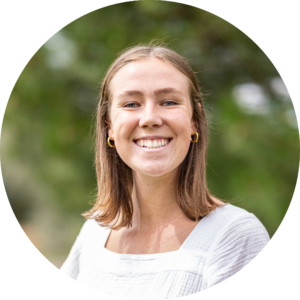
Editor's note: We recently welcomed Ashley Hales to the Denver Institute team as director of storytelling. Ashley and I talked about her prior work, her interest in Denver Institute, and what she’s most excited about in her new role. Our conversation below has been lightly edited for length and clarity.
GB: How did you first connect with Denver Institute?
AH: I’ve had a lot of connections to the faith and work movement through friends and family. My brother-in-law, Carter Crockett, has been involved in entrepreneurial and faith and work spaces for a long time, so I knew he was familiar with Denver Institute. I’d also heard good things about the organization through ministry friends in the Denver area. When I mentioned Denver Institute to people during the application process, one of the first things they would say was, “Those are such great people.” It was really encouraging to see a mission-minded, faith-based organization coming alongside people as they live out their Christian commitments in community.
GB: What was it about Denver Institute that piqued your interest?
AH: The role itself was exciting to me for a lot of reasons, but as I got to know the team, I was really impressed by the culture and the communal rule of life. I think a challenge for faith and work organizations is that you have to emulate the things you're talking about. You can’t just tell people; you actually have to embody them. Through my interactions with the team and conversations with others who knew Denver Institute, I was encouraged and delighted by that confluence of thoughtfulness, faithfulness, and, as I got to know the team better, playfulness, too.
GB: What previous work experience do you bring to the role?
AH: Most recently, I spent nearly two years at Christianity Today as the print managing editor, helping shape the vision for each issue and working with writers, reporters, designers, and art directors. Before that, I worked with Russell Moore on his podcast, giving me experience in both media and print journalism. I’m also the author of Finding Holy in the Suburbs and A Spacious Life, and my husband and I co-authored a Bible study on the Sermon on the Mount. During the pandemic, my husband and I started the Willowbrae Institute to help resource churches around cultural conversations, and I continue to speak at conferences and churches as well. I started my career thinking I would become an academic and earned a PhD in English Literature, and I still love teaching. When I trace all the bits of my story—higher education, different forms of media, writing, and a lifelong fascination with stories—it feels like this role both makes a lot of sense and is God’s kindness showing me how he sees all of who I have been and am.
GB: What will you be doing in this new role at Denver Institute?
AH: The simplest way I’ve learned to describe my role is that I’m helping Denver Institute and our CityGate partners think about how to tell better gospel stories. How do Christians integrate their faith and work, and how can stories help people imagine a new way of life? A big part of my role will be helping develop regular storytelling trainings, building relationships with CityGate partners, and creating systems to tell their stories well. I’m really excited about figuring out how and when we tell stories so they’re not just more content, but an intentional part of transformation for people listening, reading, or watching.
GB: What is it about storytelling that interests you? How do you see storytelling as an outworking of your faith?
AH: For me personally, reading good books–especially fiction and narrative poetry–was really important in my imaginative development. I’ve always loved reading as a place where you can try on different selves and learn how to see the world in an empathetic, imaginative way.
When I wrote my first two books, I included a lot of personal anecdotes and stories as a way to process how to connect what Scripture says about things–like consumerism or busyness–with my lived reality. Storytelling became a way to connect those dots, and then invite readers into that same process in their own lives. I also learned that the more specific and concrete you are, the more universal the story becomes.
We also see this in Scripture. Jesus primarily taught through stories, and the whole Bible is really a story: creation, fall, redemption, and the consummation of all things. We all live by a story, whether we realize it or not, and the gospel story is the one I most want to belong to and root my life in.
GB: Why is Denver Institute’s work important to you?
AH: What really drew me to Denver Institute is that it’s both theologically grounded and intentional, and yet not abstract in its application. We’re serious about thinking theologically, but always trying to connect those dots between our lived experience of work and the reality of God’s kingdom. I love that the team is ambitious without being strivers. People seem to genuinely enjoy each other, love the work they do, and are excited to build something together. Everyone trusts each other really well and there isn’t this weird hierarchy. There’s an openness and admiration for what everybody is good and gifted at—and a real humility too.
GB: What excites you most about the storytelling initiative?
AH: I’m so excited to begin crafting a theology of storytelling—why and how stories matter in our work and discipleship processes. When Jeff Hoffmeyer shared that as one of my first projects, I remember thinking, “You realize that’s a life’s work!” and he knows that. It’s exciting to get paid to do something I want to do anyway, and to have the time and space to dig in. As a previous teacher, writer, and speaker, I’m also really looking forward to the storytelling trainings and getting to know CityGate partners. I place a high value on connection with people and I think a lot of the real impact happens when people are in the room together. And I’m excited to be part of such a healthy organizational culture—people who love Jesus and are open to what he’s doing.